Friday, June 15, 2012

A Beautiful Chaos

Day 145
The Daily DuBrule

I spent the winter teaching about blended gardens. This means that you weave edibles and ornamentals in together. Well, I think my garden has become the poster child for this style, but probably in a way that would drive most people crazy. In reality, I have had the busiest spring, and it looks like I am going to have the busiest summer ever at Natureworks. I continue to plant and harvest food every week from my 14 raised beds, but it doesn't look AT ALL like my vegetable gardens of past years. A beautiful chaos reigns and it takes a bit of getting used to. I think I like it! It's like an edible cottage garden out there...


Mustard 'Ruby Streak's has gone to seed and flower and hangs over the radishes which grow amongst the 'Sea of Red' lettuce. In the background, half of a bed is filled with feverfew. I need to get it out and plant something edible in there but for now, I haven't the time so it's pretty and I leave it. 
 
Calendulas are absolutely everywhere, and so are breadseed poppies. I sowed 'Heirloom Pepperbox' seeds in late winter on a whim and they came up everwhere. The calendulas are throughout the bed where I planted peppers and eggplants.  


The blueberry patch has peppermint as a ground cover. It is next to old fashioned orange daylilies and circle flower (Lysimachia punctata). They both try and creep into blueberryland, but I maintain a boundary between them. Yet, it's sure a pretty picture right now as I am beginning to eat ripe blueberries and hang out there every evening for a while stuffing my face. 


A giant hollyhock has emerged in one bed. I banished hollyhocks a few years ago because I couldn't stand the rust. This one is so healthy and happy, I can't help thinking it loves the gorgeous, carefully amended soil of my veggie beds. I am allowing it to remain, even though it literally takes up 1/3 of this 12' long bed. Peas are growing on the trellis behind it and bronze fennel continues to try and grow everywhere. I also pull a lot of it out but it is just so good for the beneficials.


All these ornamental flowers are stopping my husband and I from being overwhelmed by produce. I literally give away food to my staff and anyone who will take it. Right now its greens. Last week it was garlic scapes. Tony won't let me share the radishes, they are HIS to devour. But I have to say this is a pretty good way to grow food if you are really busy and love beauty.

Thursday, June 14, 2012

My Belles


'Annabelle'
Day 144
The Daily DuBrule

Hydrangeas are a beloved plant yet they remain a mystery to so many people because very often they don't flower. When I teach hydrangea pruning I usually pack the house and many of the students come back and take the workshop over and over. All this old wood-new wood talk confuses them. Enter our fabulous native Hydrangea arborescens. No worries about pruning there. You could do what my late father used to do which is mow it to the ground every fall. It would grow back and flower every single year. That's because this species of hydrangea blooms on current year's wood. It is also hardy to zone 4 so there are no worries about hard winters or early spring frosts. Oh, and did I mention that this species will grow in lots of shade as well as full sun? How versatile of her.

For decades, there were two choices: the straight species, with nice, small white flowers that didn't fall over in the rain and 'Annabelle', with gigantic white flowers that turned heads but were a bit floppy when fully in bloom. This plant only came in white, with the flowers fading to a limey green in late summer. 

Enter 'Incrediball', bred to have the same gigantic flowers on stronger stems. Alright, someone finally figured out the flaw that made so many people annoyed at this great shrub. But that didn't solve the problem of color. Finally, a couple of years ago, Hydrangea arborescens 'Invincibelle Spirit' joined the party. This was the very first PINK form of this very hardy and easy care hydrangea.  Anyway, we were all really excited. BUT, when 'Invincibelle Spirit' finally arrived, I was less than enthusiastic about her performance and vigor. I took one home, the last, lonely, sad little plant left in the nursery in late fall, and planted it next to my smokebush. It took two years for this belle to come into her own. Now she is a true beauty.
'Invincibelle Spirit'

I was at a winter conference listening to my woody plant guru Michael Dirr shortly afterwards. He said "forget 'Invincibelle Spirit', I have bred 'Bella Anna' with is a far superior pink plant." I was excited. Well, my experience has been that yes, 'Bella Anna' is terrific, but it also needs a couple of years in the garden to settle in and come into her own. No matter, I love them all. They make great cut flowers, they are just beginning to bloom this week, and will add color to my borders for a good portion of the summer. This is one hardy hydrangea that is really worth planting, no matter what conditions you have in your garden.

'Invincibelle Spirit' with my purple smokebush


Wednesday, June 13, 2012

Glowing Golden Goodness

Day 143
The Daily DuBrule

One of the benefits of owning a retail garden center and being a garden writer is that you occasionally get offered free stuff. I happened to see a form this winter from Renee's Seeds offering free seed packets to trial. I decided to get one packet each of assorted edibles that I normally wouldn't plant and write about them. 'Pot of Gold' Swiss chard has turned to be one of my new favorites!

I first decided to try this because I love to blend pretty edibles into my flower gardens. I figured this would be an easy one. I don't eat a lot of chard because my husband prefers bitter greens and I only cook for the two of us. Now that I have a huge patch of gorgeous 'Pot of Gold', I am cooking with it all the time. I sneak it into rice, pasta, and chicken dishes. I cook it with garlic scapes. YUM! It is tender and delicious. I dragged out a book I bought back in the 70's when I had my very first huge vegetable garden: Too Many Tomatoes by Lois Burrows and Laura Myers. It's a miracle that I have managed to keep this book through over 40 years of moving, even during my time at the cottage when I had no sun and very little soil and couldn't grow much food. But there it sits on my bookshelf and it is divided up into chapters based on what vegetable is overflowing your harvest basket at the moment. I remember now that I used to cook brown rice with all sorts of spices, wilt the chard, roll the rice mixture in it, then place it in a pan with tomato sauce and cheese and bake it. 


Back to my original premise of growing 'Pot of Gold' chard as edible landscaping plant. I imagine it in my flower gardens, with purple poppies coming up through it. I can see it behind my new yellow Leucanthemum 'Banana Cream' (Shasta daisy). It has a bold leaf, so I need to pair it with plants that have a finer texture. It would even work in containers with my 'Mrs. Cox' geraniums. Fun, fun, fun times in the garden this year! 

Tuesday, June 12, 2012

Smokin'!

Day 142
The Daily DuBrule

I remember a long time ago I planted a golden chain tree in a client's yard. This man's delight in his evolving garden was a joy to behold. He called me one May day and told my "my golden chain tree is chaining!". I cracked up and never forgot that comment. Of course, it caused me to extrapolate that concept to other plants. The natural segue was "my smoke bush is smokin'!" So on Sunday, when I walked out into my garden, that is exactly what I said to myself. 

I have two smokebushes (Cotinus coggygria). The one pictured above is 'Young Lady', so named because it blooms at an early age. Boy does it. I've only had it in the garden for a few years and it has bloomed every June since I planted it. Right now I have milkweed in flower, weaving its way into the puffy blossoms. I leave as much milkweed as I can for the monarch butterflies and I also love their funny round flowers that smell so wonderful. 
Last year, in July, when my father died, I picked a huge bouquet of smokebush flowers and put them in a vase in my living room to decorate the house for company. I neglected to refresh the water and they dried beautifully, remaining there well into the fall.

The other smokebush that I have is Cotinus coggygria 'Royal Purple', or the purple leaf smoke bush. This lives in my courtyard. It is a subtle bow to the wood fired pizza oven that shares that space. Anyway, this plant is also in flower, but the flowers are light purple and not as puffy and showy. I like them anyway. The flowers appear on the tips of last year's wood, and this plant was bent to the ground in the October snowstorm. Rather than pruning it back, I quickly brushed off the heavy snow and encouraged it to stand back up on its own two feet. It did, in a quirky kind of way, looking a bit open and gangly all season. But, if I wanted flowers, I had to leave it alone. In August, once the flowers have finished, I will give it a really good, proper shaping. The bottom of this plant has already been pruned as it leaned over the labyrinth and I couldn't walk it without going off track. The result of this fall pruning is that the lower half of the plant is fat, full, and gorgeous- but no flowers. That's okay with me. In England, this plant is grown in the background of the borders and pruned constantly to encourage the best maroon foliage. No one seems to worry that it doesn't flower. I also like to cut the branches of my purple leaf smoke bush in the fall for arrangements. As the weather gets cold, the veins start to turn bright pink. The round leaves hold up really well as cut foliage. 

Monday, June 11, 2012

Calendulas


Day 141
The Daily DuBrule


What a miracle. I haven't really planted calendulas in my garden in a few years yet they continue to self sow. I LOVE plants that do that! I am getting pretty good at recognizing them as tiny seedlings and moving them around as needed. Right now, most of my raised beds have calendulas in them somewhere. I just love this common annual. It's actually a really useful herb. I recently developed a heat rash on a crazy hot day in the attic office of Natureworks. When I got home I grabbed my calendula cream and it solved the problem in a few days. It is good for any skin irritations. It is also a culinary herb, often called "pot marigold" as it can be used as a saffron substitute in rice and stews to color to dish orange. 

Just look at the variety of flower forms that I photographed this morning in my garden. There are orange ones, yellow ones, singles and doubles. Some have deep red centers, some have bright yellow centers.The petals of the flowers are edible and delicious sprinkled in salads. The flower petals are also a source of yellow dye. They bloom all summer and continue into the fall. Grown in Europe since ancient times, it is one of the most valuable herbs you can incorporate into your gardens. Just pick up a packet of seeds or a couple of small plants and off you go!


Sunday, June 10, 2012

Nodding Onions

Day 140
The Daily DuBrule

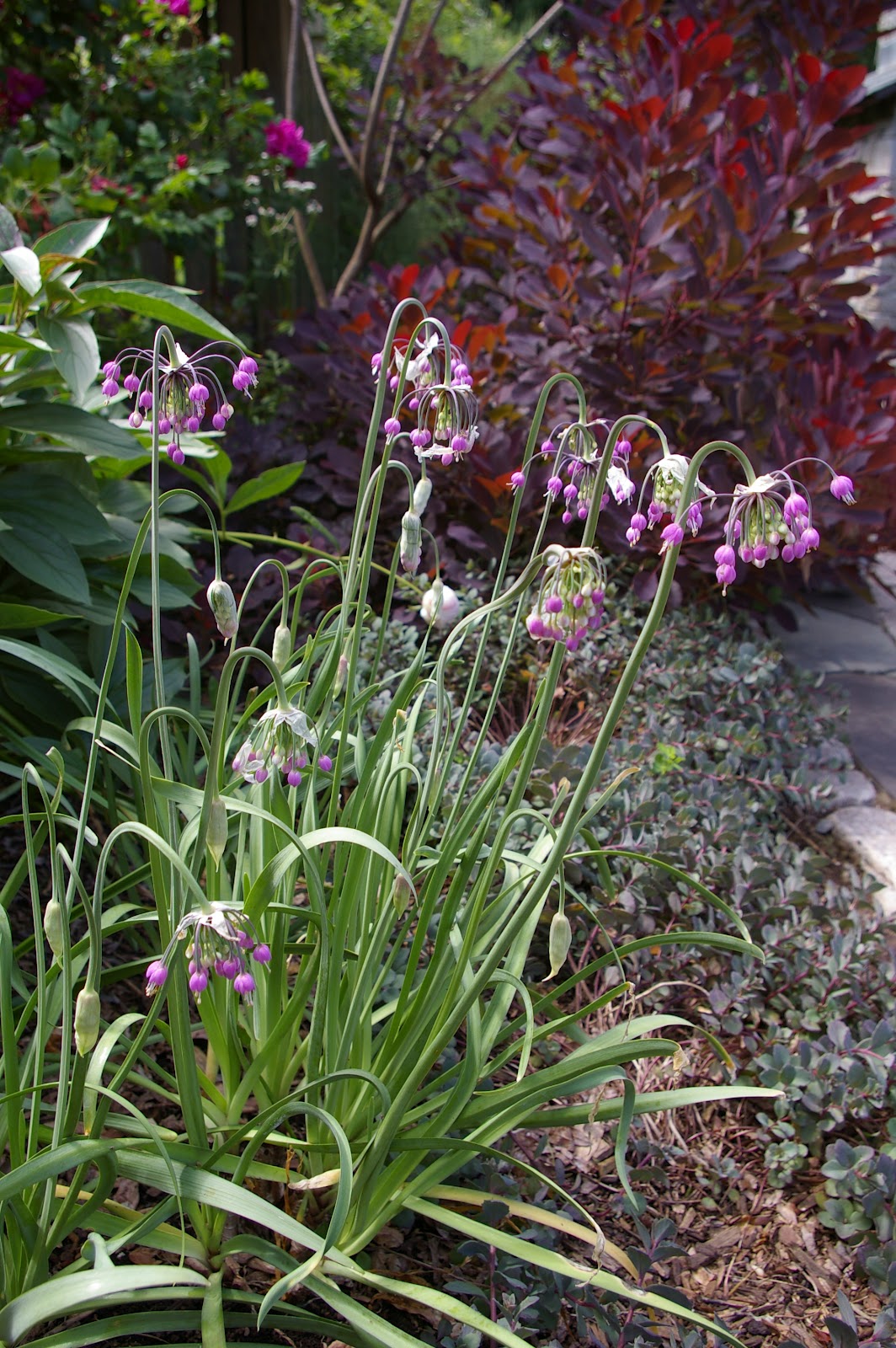
I am a sucker for Alliums. I just simply love the genus and everything in it. I am presently harvesting and eating garlic scapes and giving them away to anyone who expresses an interest. I am enjoying Allium shubertii and Allium cristophii in my gardens. I snip chive and garlic chive leaves for my salads. I probably have an Allium in bloom every week of the growing season. 

When I heard about Allium cernum and realized that it was a northeast native plant, I had to have it. I gave it a place of honor in my courtyard, right by the steps that I perch upon to have my coffee. It rises above a generous patch of Sedum 'Bertram Anderson' and sits in front of my favorite peony 'Nancy Nora', pale pink and sweetly fragrant. Ms. Nora is just finishing her blooming cycle, with the secondary buds opening nicely just as the nodding onion is living up to it's name. The nodding buds are a joy to watch unfold.

I could spend hours photographing this plant from every angle. I won't do to mix it in a jumbled border. It must be placed where the motion and flow of the dangling stems pop against the neighboring plants. I even leave the seed pods on for a good long time afterwards as they are architectural and any free self-sown babies I get as a result are welcome. Oh, and did I mention that both the florets and the leaves are edible? 

Saturday, June 9, 2012

'Bella Blue'


Day 139
The Daily DuBrule

I am a sucker for any plant named Bella. I have a cat named Bella who would melt your heart if she ever let you get near her. She was adopted as a tiny kitten after being found under a car. We call her our "special needs cat" as she is a nervous Nelly. My husband and I have figured out how to make her very happy and she is the light of our lives.

Back to 'Bella Blue'. This is a new Prunella grandiflora, a plant that is so ignored in my field that I was stunned to not only see this offered by one of my growers, I was also very pleased to see what the breeders have done to make this plant much more garden worthy. You may recognize this perennial, as Prunella vulgaris is a weed in some gardens, with pale pink spikes about an inch tall. 'Bella Blue' has deep purple flower spikes 15-18" tall and will repeat bloom throughout the summer.

I discovered Prunella grandiflora decades ago, and even used to talk about it in my perennial garden design classes as a long bloomer. Then it dropped from the radar screen of all of the growers and no one seemed at all interested. It is really hardy and easy to grow and durable for sun or partial shade. 

My Bella
Prunella also sounds like one of Cinderella's ugly stepsisters. An unfortunate name for quite a cute little plant.