Day 158
The Daily DuBrule
I am slipping in my plan to post daily on my blog. I have been out of town, and now I am taking a brief vacation. I expect my posts will be a bit more thoughtful, but probably less frequent as I will do a bit more traveling later this week to Boston.
I looked out my study window Saturday morning, the last day of June, to see my rose of Sharon in bloom. This is not an ordinary rose of Sharon. This is Hibiscus x 'Tosca', a hybrid and much larger growing variety that originated at Winterthur in Delaware. I was taken by this plant years ago because the flowers are huge compared to regular rose of Sharon trees. They measure 5-6" across! The leaves are also quite large, giving the entire plant a tropical appearance. I do not yet know the parentage of this plant, but I will say that it is much earlier to flower than any other rose of Sharon trees I have ever grown. It blooms on current year's wood and I neglected to give it the hard pruning in the spring that I usually do, so it fills up an enormous space in the border opposite my study window. Just last night I did a bit of "cutting windows", pruning some overhanging branches on this tree and a neighboring Baptisia to liberate a gorgeous 'Fireball' bee balm growing below.
I have grown this plant, and it's cousin 'Lohengrin' which is white with a ruby center, in many of my client's gardens. It is a vigorous and carefree summer bloomer. I have seen people cut this to the ground each spring and grow it as a 4-5' shrub. I have seen people pinch it hard a month after it leafs out to cause it to branch and bloom later. I love to see it get big and offer a very dramatic presence in my yard. The hummingbirds love it and the butterflies do too. References to this plant say that is is sterile but I have to disagree. I have baby seedlings appearing nearby. I pull them out as one plant is all I have room for. Perhaps I should pot them up and grow them on. Maybe I would end up with a new color of this oversized hibiscus.
Natureworks was started by Nancy DuBrule in 1983. With $500 and an old orange Datsun truck, Nancy began taking care of gardens in the Branford area. Within a year, Natureworks opened a retail store in a converted gas station in Stony Creek. In 1990, Natureworks moved to Rt. 22 in Northford. An older home was converted to the garden center, surrounded by organic demonstration gardens. Natureworks now employs up to 25 people during the growing season including landscape, retail, and office staff.
Monday, July 2, 2012
Saturday, June 30, 2012
My Daylily Border
Day 158
The Daily DuBrule
When I moved into my house I decided to eliminate the lawn on the steep slope by the road. It was the perfect place to dump the boring 'Stella D'Or' daylilies and plain old green and white hostas that the previous owner had planted everywhere. I rode the manual desodder down the hill and transplanted these run-of-the-mill perennials to this spot by the street.
My plan for my front yard has always been to keep it simple. I garden in public all day. When I am home, it is my only chance to garden alone. I didn't want to make the front gardens complicated or high maintenance. The second year I added some gorgeous red daylilies that I was given by a client (pictured above). I never did find out their name but they are early and start blooming just after the Stellas get going. It was then that I decided to have a theme for this hillside- bright oranges, golds, and reds. I was off and running.
Next to go in was 'Spider Miracle'. I started selling this variety because 'Lady Fingers', one of my favorite varieties, wasn't available. This is very similar. I wanted to be sure I could have stock of this neat plant for jobs in the future. It has thrived and I have huge clumps five years later.
'Bertie Ferris' was next. She is an adorable miniature repeat bloomer with really bright orange flowers. She just goes and goes and is way more interesting than good old 'Stella'. Love this plant!
I discovered two very deep golden yellow, large flowering daylilies that caught my eye. The first, which is pictured above, is 'Mary's Gold'. The color isn't right in this photo, is is a deeper golden orange. Really close is 'Spellbinder'. I need to add that one to the border so I can study the difference between them. I also planted 'Condilla', a Trophytaker brand variety with double golden orange flowers that blooms for more than 6 weeks.
Near the mailbox is a huge stand of Hemerocallis fulva 'Kwanso Flore Pleno', the classic double orange roadside daylily that was given to me by my friend Ruth Kurle. This really goes the distance, flowering for many weeks longer than the single type. It is a real workhorse. Every time I see it, I think of Ruth.
Throughout the past few years, I have continued to add to this crazy, mixed up collage of hot colors. I placed bundles of dried Rudbeckia 'Goldsturm' seed heads between the daylilies and stomped on them late one fall. Now, they mingle with the daylilies and add a blast of color in August as the later blooming varieties are opening.
Honestly, I never feed this garden, barely weed it except to pull out maple seedlings and bittersweet babies. Once every few years I toss some mulch at it. It is informal, easy, interesting, and I see people stopping to admire it when they walk by. Oh, and did I mention that it is filled with daffodils in the spring?
Thursday, June 28, 2012
My Fragrant Oasis
Day 157
The Daily DuBrule
Tonight I do a garden walk about fragrant plants. When I designed my own gardens, fragrance was at the top of my criteria list. It was especially critical that I surrounded my deck with plants that were fragrant, as that is where I spend time relaxing, especially in the evening.
I am very proud of my O.T. lilies. I love the variety 'Conc d'Or' which is an oriental/trumpet cross that soars to six feet and fills my entire yard with its powerful perfume. Four months of persistent lily leaf beetle control is worth it when they flower.
The tree I chose to shade my deck is Clethra barbinervis. This is a tree form of Clethra or summersweet. I first discovered this plant on a summer nursery tour. I look up at this 20 foot tall mature tree buzzing with bees, smelled the sweet fragrance, admired the cinnamon colored bark, and fell in love. The above picture was taken a few years ago when the tree was small. I had to use roll down shades to keep the sun off the picnic table in the afternoon. Now, this tree is large enough to shade the deck. When it bursts into bloom and the 'Conc d' Or' lilies flower at the same time, it is paradise out there.
Tuesday, June 26, 2012
My Favorite Hydrangea
Day 156
The Daily DuBrule
I am in love with oakleaf hydrangeas. I love the fact that the flowers are fragrant. We're not talking the powerful perfume of a trumpet lily, the scent is light and soft and sweet. They are dramatic plants. Their branches reach out in all directions like a living piece of sculpture. Most hydrangeas in the winter look like dead sticks. Hydrangea quercifolia has an interesting exfoliating bark and makes the winter landscape much more interesting.
The flowers are borne on the tips of last year's wood, so that makes pruning a challenge. After they finish blooming, and while the beautiful dried flowers are still on the plant, any pruning should be done to shape the plant. I am not suggesting you cut the entire plant back. Instead, select out some branches that have gotten too long and dangly and cut them back to where you want branching to occur. Perhaps remove some of the older branches that may be weak and break in snowstorm back to the base. This is pruning as plant sculpting and it takes patience and a good eye.
In the fall, the second show begins. The foliage turns a deep, rich, burgundy red. It is one of the highlights of the late season garden. Oakleaf hydrangeas are native plants, attract pollinators galore, and will grow in sun or shade. They are hardy in a cold winter and not susceptible to common garden pests or diseases. All in all, they are an excellent addition to the landscape.
Monday, June 25, 2012
Popper Party Time!
Day 155
The Daily DuBrule
The heat of last week moved a lot of plants into fast forward. One of the benefits of this weather is that my magic evening primroses have started to open. Affectionately called "poppers" by those of us who grow them, their official scientific name is Oenothera glazioviana 'Tina James Miracle'. Now that's a mouthful! They are true biennials. The first year they are rosettes of green leaves and look just like many other weeds in the garden. You have to know what they look like or you could easily pull them out. The second year they send up long flower spikes that can eventually reach 4-5' tall. Each day, buds start to swell. In the evening, at the magic hour when the sun has gone down and before it gets dark, the flowers open...right before your eyes they unfold... slowly... magically. A gentle "pop". People can't believe it! It takes patience (a good glass of wine helps) and faith. Impatient folks leave before the show begins. But once you've seen it, you treasure the experience.
Poppers are pollinated by night flying moths. They emit a very sweet perfume. When you stick your nose deep in the flower, you always end up with a bit of pollen on the end of your nose. The time that they open changes as the time that the sun sets gets earlier and earlier. We've already passed the summer solstice, the longest day of the year, so it's all downhill from here. The timing of the opening of these flowers makes you realize how the length of the day keeps diminishing. In late summer, they get pretty ratty looking, with less and less flowers and more seed pods ripening. It's critical to let them form ripe seed, for without that seed, the cycle ends and you lose your poppers. The following spring, watch for the babies. Don't expect them to be where the poppers were last year. Mine have moved from their original location in my side yard by the deck, to the courtyard, and now to one of the raised beds in my vegetable garden. My husband has stopped wondering where I am after dinner and dishes. He knows I got out, graze on the sugar snaps, raspberries, and blueberries, and then wander over to these magical flowers and wait to watch them open. I am like a little kid, I never get sick of seeing it happens. It makes me smile.
I got my original plants from my employee Lisa who got them from David Brown of Old Saybrook who owns the Hay House Farm. I have shared my plants with friends and propagated them for the nursery. Because we are never open as the sun is setting and the poppers are popping, it doesn't really do any good to plant them at Natureworks. I get to enjoy them here at home, night after night, as the summer unfolds.
Tina James, by the way, was an author who knew about these plants and had parties with her friends to celebrate watching them open. I've done that myself. Once you have seen this miracle, you want to share the experience.
A couple of years ago I made a video showing this happening. It is really silly, I ramble on and on, but it sure is relaxing. Birds chirping, my water garden in the background, four and a half minutes devoted to watching the magic evening primroses open. Check it out. Enjoy. Watch poppers:the video
The Daily DuBrule
The heat of last week moved a lot of plants into fast forward. One of the benefits of this weather is that my magic evening primroses have started to open. Affectionately called "poppers" by those of us who grow them, their official scientific name is Oenothera glazioviana 'Tina James Miracle'. Now that's a mouthful! They are true biennials. The first year they are rosettes of green leaves and look just like many other weeds in the garden. You have to know what they look like or you could easily pull them out. The second year they send up long flower spikes that can eventually reach 4-5' tall. Each day, buds start to swell. In the evening, at the magic hour when the sun has gone down and before it gets dark, the flowers open...right before your eyes they unfold... slowly... magically. A gentle "pop". People can't believe it! It takes patience (a good glass of wine helps) and faith. Impatient folks leave before the show begins. But once you've seen it, you treasure the experience.
Poppers are pollinated by night flying moths. They emit a very sweet perfume. When you stick your nose deep in the flower, you always end up with a bit of pollen on the end of your nose. The time that they open changes as the time that the sun sets gets earlier and earlier. We've already passed the summer solstice, the longest day of the year, so it's all downhill from here. The timing of the opening of these flowers makes you realize how the length of the day keeps diminishing. In late summer, they get pretty ratty looking, with less and less flowers and more seed pods ripening. It's critical to let them form ripe seed, for without that seed, the cycle ends and you lose your poppers. The following spring, watch for the babies. Don't expect them to be where the poppers were last year. Mine have moved from their original location in my side yard by the deck, to the courtyard, and now to one of the raised beds in my vegetable garden. My husband has stopped wondering where I am after dinner and dishes. He knows I got out, graze on the sugar snaps, raspberries, and blueberries, and then wander over to these magical flowers and wait to watch them open. I am like a little kid, I never get sick of seeing it happens. It makes me smile.
I got my original plants from my employee Lisa who got them from David Brown of Old Saybrook who owns the Hay House Farm. I have shared my plants with friends and propagated them for the nursery. Because we are never open as the sun is setting and the poppers are popping, it doesn't really do any good to plant them at Natureworks. I get to enjoy them here at home, night after night, as the summer unfolds.
| Chairs set up to watch the show |
A couple of years ago I made a video showing this happening. It is really silly, I ramble on and on, but it sure is relaxing. Birds chirping, my water garden in the background, four and a half minutes devoted to watching the magic evening primroses open. Check it out. Enjoy. Watch poppers:the video
Sunday, June 24, 2012
A Sparkling Evening
Day 154
The Daily DuBrule
I used to live in a wonderful small community by the shoreline. It was surrounded by marshes and contained patches of inland wetlands. There was also plenty of woodland areas filled with wildflowers and, of course, beaches and water views.
Every 4th of July, folks would stage a magnificent private fireworks display on a rocky outcropping that jutted far out into the water. Everyone on the island knew this was going to happen. People would have cookouts and party all day in anticipation of this event. At dark, we would all proceed to the beach and enjoy the show.
Walking home after the fireworks one year, I stopped at the marsh and simply stood there for five minutes watching a quiet display of sparkling lights- lightning bugs! It was the neatest phenomenon, watching this long stretch of marsh twinkling as the last of the smaller fireworks popped all around. I will never forget that feeling.
Last night, after returning home from a nice dinner party, the air was just so deliciously cool after the intense heat and humidity I endured all week that I just couldn't help myself. I stretched out on the lounge chair on the deck to breath in this air and think about the week that just past. It was then that I saw the first lightning bugs of the season. As they sparkled and twinkled around my garden, I settled in for a while to deeply relax and untwist my muscles and thank goodness I live in such a special patch of paradise.
Saturday, June 23, 2012
Those Sneaky Hollyhocks
Day 153
The Daily DuBrule
Many years ago I banished hollyhocks from my garden. It was a heartbreaking decision because I adore these old fashioned flowers. They are dramatic AND they attract hummingbirds.
I remember the exact moment when I decided that enough was enough. It was an extremely mild winter, 70 degrees in January. I was out poking around in the yard and I found hollyhock leaves unfolding up against the south side of my house. They had rust on them! Are you kidding me? Rust in January? I grabbed a garbage bag, dug out the plant, threw it away, and washed my tools off with rubbing alcohol. After that, any babies that appeared were ripped out.
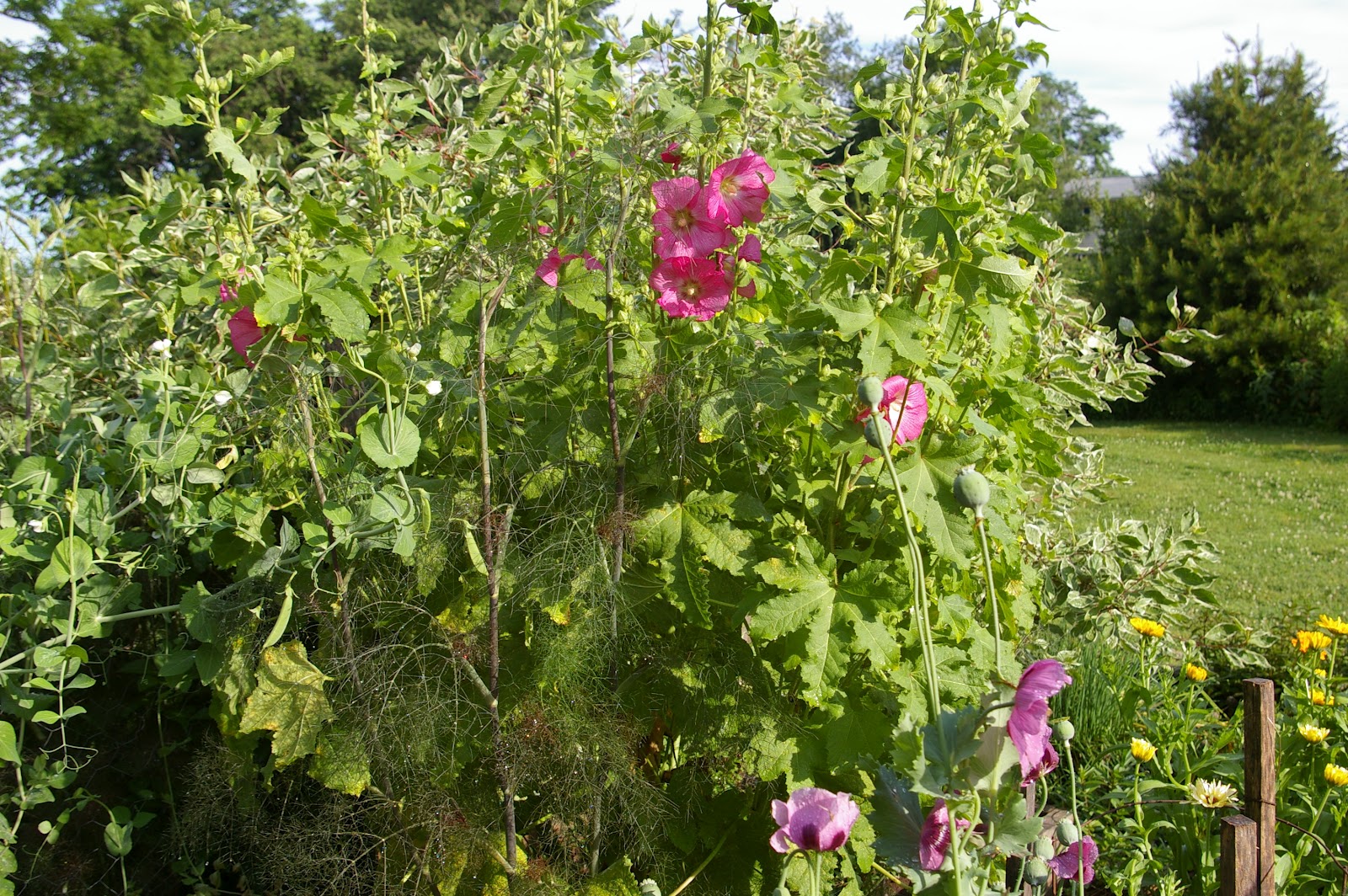
That plan worked well for the past few years. This year, however, a couple of seedlings appeared and, for some reason, I left them. One was in the original spot on the south side of the house. The other was in a raised bed in my vegetable garden. They are both now in bloom and remarkably rust free. Well, I see a tiny bit starting on the lower leaves, but they are nothing like the fungus covered plants of the past. I owe it to my extremely rich soil. This is an unscientific theory, but when you think that holllyhocks used to be a staple next to outhouses and barns where the soil is very rich... well, I just might be onto something.
The red one is right by my back deck and my resident hummingbird is really happy with it. I can see it out the window as I type this. The pink one is over four feet across and takes up 1/3 of one entire raised bed. The peas are squeezed in next to it. It is the biggest, healthiest hollyhock I have ever seen. I will probably remove the lower leaves and discard them and when the flowers finish, I will cut all the stalks down except one and let it go to seed. Then I will take the ripe seed and move it somewhere else in the yard. I guess the hollyhocks have snuck back in and won a new place in my garden, and in my heart. I am just a sucker for these classic cottage garden flowers.
Subscribe to:
Posts (Atom)