Day 102
The Daily DuBrule
Sunday is my gardening day. I have almost two acres and about 4 hours to care for them a week so let's just say I get a little behind. Sunday I started to remove the 'Lemon Queen' sunflowers from my gorgeous clump of deep purple, double Japanese irises. I love both these plants, but the perennial sunflower spreads really fast and grows 6' tall so it needed taming. I had the bright idea to move it to the back border, replacing an invasive plant that needed to GO.
Let's just say that I did a lot of digging. Digging up all the lemon queen was easy. I dug up a fair amount of gooseneck loosestrife as well. I inherited this insane spreading white flower when I bought the property and it is trying to take over my universe. I am surprised that it is not on the invasive list in CT. Truly.
The invasive plant that I was dealing with is Silphium perfoliatum, called the cup plant or compass plant. I have to say this plant gave me great joy in the early days of my gardening career when it was sold as a bold, late summer flowering perennial and I planted it in the Natureworks gardens. Everyone asked about it. I called it the living bird bath as the foliage meets the stems and forms cups that fill with water. I would tip the plant over during my walks and show people how much water would pour out. Even dew would collect in these cups.
Imagine my surprise when this plant appeared on the invasive plant list as banned in CT. Alan Armitage writes about it as a U.S. native. It was also listed in other books I had as native. It turns out it is native to the tall grass prairies of the midwest. In fact, it is listed as endangered in Michigan. Not in Ct. It spreads really fast here and because it is not native to CT, it made the list. This plant seeds like crazy. The seedlings immediately root hard and fast into the ground. You can't pull them out, you have to dig them out. That is what I did for four hours. Heavy duty digging, getting the babies and established clumps out to make room for new plants, including my 'Lemon Queen' sunflowers which, by the way, are still soaking in a wheelbarrow of compost water as I ran out of steam and never planted them.
The lesson here is that native is not always native. It depends on where it is native to. After owning my business for nearly 30 years, I have many stories of plants we were sold as the next great plant only to find ourselves ripping them out years later. Burning bushes. 'Rosy Glow' barberries. Lythrum. We plant, we learn, we change, we adjust. And we dig.
Monday, April 30, 2012

Saturday, April 28, 2012
Coral Fay

The Daily DuBrule
I have a peony in bloom on April 28th! For anyone who keeps track of these things (that would be me), those are strange words. Peonies are late May and June bloomers. Tree peonies usually bloom first, followed by herbaceous peonies. 'Coral Fay' is an herbaceous peony (it dies to the ground in the late fall). It is a bit shorter than my other peonies and the foliage is distinctively different, a little more finely cut. I have read that it is related to the fernleaf peony. The color is rich and vibrant.

As I walk around my yard observing the progress of my many other peonies, I see the buds swelling and the ants crawling on them. They are after the sticky sap that the buds exude. We prefer to say that the "ants are tickling the peonies" to help them open. The pattern of our plants being 2-3 weeks ahead of schedule continues. Even with the very cold nights and chilly days we have experienced this week, the peonies seem determined to put on their brief, but grandiose display for Mother's Day instead of Memorial Day.
My Mustards
 |
| 'Ruby Streaks' |
The Daily DuBrule
First of all, I have to say that I am amazed I have hit DAY 100 of this blogging business. Now onto the subject at hand...
I discovered mustards a few years ago when I was given a paw paw tree and there were mustard greens growing at the base. I nibbled on them and was amazed that they were spicy and delicious. That winter I attended a talk at UConn given by Rosalind Creasy, my Edible Landscaping guru. She discussed mustards and said "whenever you would use mustard from a jar, use mustard greens." I remembered that.
In the spring, I sowed my first seeds of 'Ruby Streaks' mustard. It was on the top of my list as an edible landscape plant with its ferny foliage and deep wine color. It grew like crazy and I did just as Rosalind said and put the leaves on my sandwiches. Yum. Of course I ate them raw when in the garden and I used them in stir fries.
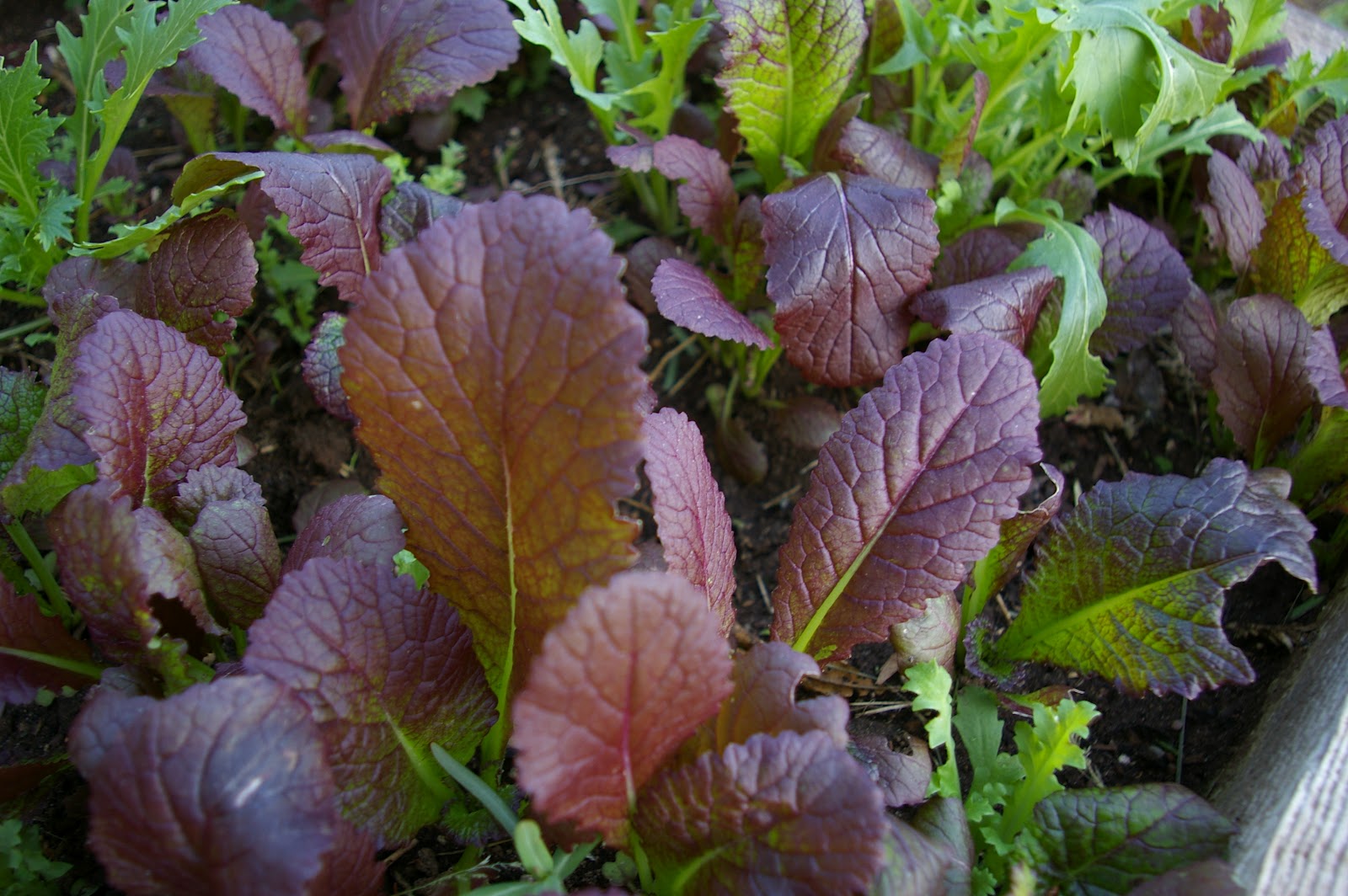
 |
| Mizuna in the middle of red mustard |
So right now I am eating lots of mustard and mizuna from my garden and I haven't done a single thing to have them there except plant some seeds in years past. Talk about low maintenance food production! Nutritious too.
Friday, April 27, 2012
Wood hyacinths

Day 99
The Daily DuBrule
Last year in early May I decided that my garden was lacking blue flowers. I had tons of Doronicum pardalianches in flower, yellow daisies everywhere. I had lots of pink due to the Silene dioica which has self sown all over the place. The giant bleeding heart added to the show. I craved blue.
Meanwhile, back at Natureworks, our shady borders will filled with wood hyacinths. Bingo. That's what I needed! I made a note of it and miraculously, despite the disruption of the hurricane and October snowstorm, I found the note, grabbed the bulbs, and eventually got them in the ground. They are starting to bud up now.
Wood hyacinths used to be called Spanish squill and there scientific name was Scilla hispanica. Simple to remember. Then the botanists changed the name to Hyacinthoides hispanica. Okay, I can handle that. The good thing about them is they appear when most of the other early bulbs are finished. They spread easily in sun or shade and make great cut flowers. I have seen entire woodland gardens naturalized with these beauties. In England, they grow
Call them whatever you want, I just think it's pretty amazing that they are now growing in my gardens, adding a much needed blue color in the land of pink and yellow. The lesson here is to take notes NOW about the bulbs you are missing. You will certainly forget these omissions by late fall. Place a little post it on your September calendar: "Buy wood hyacinths!" You will consider yourself a genius when you flip the calendar page and there it is.
Wednesday, April 25, 2012
A Neat Native Bulb
 | ||
| Camassia (Quamash) |
The Daily DuBrule
I have heavy clay soil in my back yard. We're talking the kind of stuff that you could make pottery out of. Dig a hole during a wet spring and it will fill up with water. Bulbs hate that. Except for Camassias. They thrive in wet soil. So, I planted a ton of them in my lower borders and they all started to bloom this week. They are blue. Not purple. Blue. Pretty spikes, totally perennial, soft and beautiful. I am thrilled.

With all the talk about native plants, its rare that you hear about planting native bulbs. Daffodils, tulips, snowdrops, Scilla, none of them are native to CT, never mind the U.S.A. Enter Camassias, prized by native Americans. In fact, the bulbs were eaten and ground into flour. Click here to read an interesting Wikepedia article on Camassias. http://en.wikipedia.org/wiki/Camassia_quamash They belong here and I am so glad I have a yard that makes them happy.
A Most Amazing Collaboration
Day 97
The Daily DuBruleI just found out that one of my clients passed away a couple of days ago. I am so sad. I have known this woman for decades as she loved to shop at Natureworks. A few years ago she asked me to help her with her garden. When we met that winter, she shared with me that she was very ill and knew that she wasn't going to be here for very long. Therefore, she wanted to create the garden of her dreams to enjoy in the time she had left. I was stunned with her honesty and courage.
We proceeded to collaborate on one of the most interesting gardens I have ever designed in my career. She gave me carte blanche. All she wanted was a detailed plant list so she could veto a plant that was not amazing enough. The criteria for this landscape was wild and wacky plants. Brilliant, intense colors. Fun foliage. Variegation. The crazier the better. I pulled out all the stops and put together combinations that blew both of our minds.
I hooked her up with the man who built my raised beds and he built lots of them for her. Due to her illness, she had to have tops on the sides of the beds so she could sit. Every kind of edible plant was included. She had fresh produce into the early winter and lots of it came back in the early spring. She planted perennial crops like rhubarb and asparagus.

As time went on, this brave woman rode the typical roller coaster ride of a terminal illness. Myself and my crews and staff rode it along with her. There were months of rejoicing and hope as she seemed to get a lot better. There were scary times when she was away from the garden for weeks on end. The projects just kept on coming. We rented machinery and cleared tons of invasive and enlarged the garden. We eliminated lawn and replaced it with more beds. She had contractors build an amazing, gigantic stone water feature. She had an oversized, outdoor checkerboard. We landscaped the backdrop for an inflatable outdoor movie screen and she showed movies in the summer for the neighborhood kids who adored her. Her garden was filled with pieces of custom made sculpture. Ergonomic art that moved in the wind. A giant rusty metal venus flytrap. A garden of glass flowers along the shady side of the garage. Little metal men carting around gnomes, watched over by curious pink flamingos. The yard was a wonderland.


Talk about living for the moment. This two year journey that we took together taught me so much about enjoying the time that you are given. To garden is to believe in tomorrow. I will never forget her creativity, determination, grace, and courage. Godspeed my friend.
Monday, April 23, 2012
Eewwww!

The Daily DuBrule
After a wonderful night of steady rain, I couldn't wait to go outside and see how my garden was doing. Imagine my horror when I came upon the juniper tree outside of my office window and found it covered from top to bottom with orange slime. Eeewww! I knew immediately what I was looking at and my heart sank. Cedar apple rust. When I lived at the beach, the eastern red cedar in my yard had the same problem.
Cedars and I now realize some junipers are the alternate host for this fungus. Galls form on the plants. I admit I didn't notice them and I used this juniper to make a giant wreath for my front door at Christmas time so I was up close and personal with the foliage, that's for sure. When the galls mature, they swell up after a long,cool rainy period and produce, according to www.mobot.org (the Missouri Botanical Gardens website, one of my favorite online references) "orange, gelatinous telial horns". I don't know what telial means but orange and gelatinous sure nails it. The creeping crud would be another way of putting it. These "telial horns" produce spores which infect apple trees and other members of the apple family. That is the second part of the equation- the fungus that appears on the leaves of these trees, which, according to www.mobot.org "the leaves...will develop raised orange structures that will ooze from the center, turn black, and appear as black dots. In late summer, this area will produce the orange and brown rust colored spores that will infect the juniper hose, completing the cycle." Sounds wonderful.
I don't have any apple trees nearby, but I do have a pear tree directly across the yard from this juniper. There's a quince around the corner and many of my neighbors have crabapples. Way down the hill in the back, I can see a large, old apple tree in bloom. I wonder if it will be affected?
Anyway, there's nothing I can do but stare out the window where I write this blog and watch these orange globs ooze and grow. I'm not going to cut down the juniper and if I cut them all off, there would be nothing left. Eventually they dry up and probably won't hurt the plant. I could try spraying the susceptible alternate host plants with copper but I know I won't bother considering how busy I am and how big they are. It's just one more gross, disgusting thing to observe in this fascinating ecosystem called my yard.
Subscribe to:
Posts (Atom)