Monday, November 19, 2012

A Thanksgiving Week Garden Tour

Day 247
The Daily DuBrule

Where have I been? Why haven't I been writing? I guess this time of year has me a bit uninspired. Usually I leap out of bed, my head brimming with ideas. For the past week, that hasn't been the case. It's not that I haven't been busy, or immersed up to my eyeballs in all things horticultural. In fact, I have been traveling, visiting client's gardens, working in my own garden, and I even had a vendor booth at a wonderful event at the Mark Twain House in Hartford where I got to hear (and meet and sell plants to...) P. Allen Smith. But in terms of my blog, it hasn't happened.

Today I woke up in a new headspace. The transition is over from the gardening season to the holiday season. For goodness sake, Thanksgiving is less than four days away. I need to face the facts and move on. I thought I would begin my journey back to the blogosphere with some pictures of my yard this morning. Enjoy.
Orange and red winterberries glow in the morning mist

The irises are a sea of yellow at the feet of my dogwood.

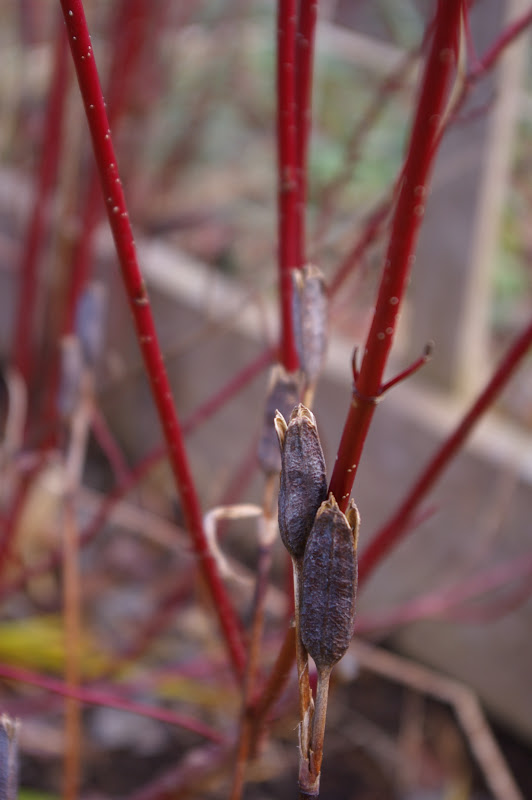
Iris pods are great in winter porch arrangements

A red dogwood? No: Rose 'Therese Bugnet'

The leaves prove it's a rose!

Buttonbush pods

Andromeda buds for my holiday arrangements.

Beautiful bark on Heptacodium.

My hemlock that I wait all year to prune for greens for swags.

Mossy green stems of Kerria are great in arrangements.

Cute little cones on dwarf Scotch pine planted last year.

Asclepias tuberosa pods still bursting with seeds.

Ilex pedunculosa in deep shade. Love this plant.

I grow Boulevard cypress specifically for holiday greens. Love it's soft and fuzzy texture.

My Leucothoe hasn't turned burgundy red yet.

Monday, November 12, 2012

Cormlets

 
Day 246
The Daily DuBrule

Yesterday I finally got around to digging my tender bulbs. Actually, what I dug were tender corms and their accompanying cormlets. I love the word cormlet, even more than I love the word bulblet, because it just sounds so fun rolling off my tongue. I'm weird like that. What is a corm? It is a fleshy storage organism for a plant. Unlike a bulb, which has concentric rings of tissue (consider the onion and you will know what I mean), a corm is a solid mass. Cormlets are baby corms and each one has the capacity to become another plant some day. 
Acidinathera, my Abyssinian gladiolus with amaranth
I was digging gladiolus and Acidinantheras-these are called Abbysinian gladiolus. I have been planting these same corms for many years and they have multiplied and gotten bigger, to my delight. I was pretty freaked out by last week's snow storm because I had so much unfinished business in the garden. My raised beds and the borders surrounding them were covered with nearly a foot of wet snow. By Sunday, most had melted but everything that remained was a sodden mess. 
Glads with 'Ruby Streaks' mustard and amaranth
I grow my gladiolus amongst other plants as I find them stiff and not very graceful alone. In fact, I never used to grow them at all until my mother died and I decided to plant them in her honor as they were her favorite flower. Now I love them. I have always grown Acidinanthera as they are sweetly fragrant. So Sunday, I attacked the mushy foliage of mustard, arugula, and borage in order to find my corms and lift them. I was relieved to find they were plump and solid, no worse for the wear despite the snow and cold. I laid them on the stone wall to dry as I continued to work in the gardens. Right before I packed it in for the day, I put them on the floor of the back garage to dry further. Once they are completely dry I will store them in the cellar for the winter and then start the cycle all over again next spring.
Corms ready for storage
 

Thursday, November 8, 2012

Saffron Crocus

Photo courtesy of Netherland Bulb Co.
Day 245
The Daily DuBrule

It's not too late to plant bulbs. Sounds crazy, I know, but this week's big snow is melting as fast as it fell and by the weekend we will see bare ground again. One of the most unusual bulbs you can add to your garden is saffron crocus. Yes, this inexpensive bulb really does produce the spice saffron which is the stigma of the flower. We have a patch of these perennial, late fall blooming crocuses (croci?) in front of Natureworks. They have a completely backwards growth cycle.

The bulbs are available in the fall and as soon as they arrive you will notice that they are sprouting and trying to grow. If you plant them in the garden, they will send up thin, grass-like leaves (they are easy to recognize as they look pretty much like the spring blooming crocuses). These leaves will grow during October and then, at the end of the month or early in November, the soft lavender flowers will appear. It is really fun to show them to garden visitors. They are usually surprised to hear that we can grow saffron in CT. I love to grab the stigma and get the dark, orange saffron on my fingers. You can taste the flavor! 

Now you will understand why saffron is so expensive. It is normally grown, harvested, dried and sold in vials or tins for as much as $75-140 per ounce. It has been called the most expensive spice in the world because it must be harvested by hand. It is usually produced in Spain, India, and the middle east. Why not try something totally new, quite delicious, and really pretty for your late season garden this year? You don't need a lot of room and you can even plant them in partial shade. The only thing to be careful of is not to dig them up in the spring and summer when they are dormant. A permanent metal label is just the ticket for this plant.

Tuesday, November 6, 2012

Blueberryscaping

Day 244
The Daily DuBrule

Sunday I planted nine blueberry bushes in my yard. Three were a highbush variety called 'Earliblue' which is, of course, early bearing. The other six were 'Tophat', a new hybrid that grows only 18-24" tall and gets full sized berries. I planted these in a newly cleared bed that used to contain gooseneck loosestrife. After two weeks of painstaking digging, I deemed the soil ready.

The purpose of clearing out the gooseneck was not to plant blueberries. It was to plant a peach tree for my husband. But the bed was huge, mostly because the gooseneck had spread an extra 2-3' out into the lawn in the eight years I've lived here. I decided to make this bed yet another edible landscaping project. The peach, the blueberries, and a border of chives created the structure. Very easy care perennials were added to introduce color in other seasons. 

Blueberries are ornamental in every season. In the winter it is easy to recognize their reddish stems in the landscape. I can't tell you how many times I meet a new client and inform them that their woods are filled with native blueberries. In the shade, they don't produce many berries but they are a great plant anyway. Spring brings beautiful white flowers. Often times it's when the native blueberries are in bloom that I spot them. Summer, of course, brings the fruit which I share with the birds. In the photo above, another form of Lysimachia, L. puncata or circle flower, has wandered in amongst my original blueberry patch. Although I have since beaten it back to a smaller clump, it sure looked pretty!
It's in the fall that the real landscape value of blueberries really shines, when their leaves turn bright red. Think about using blueberries in foundation plantings, in mixed shrub borders, even to add structure to perennial beds. They don't just have to be in rows, netted and fenced, to give you flowers, berries, and red foliage. They are ericaceous (acid loving) and can tolerate my wet, heavy clay soil. They don't need it wet, however, and average garden soil will suffice. There are now tall ones and short ones. This week I am using our native lowbush blueberries as a groundcover in the foreground of a shady foundation planting where native plants were required. The enlightened homeowner specifically requested these plants! My crew removed a truckload of English ivy and some very overgrown shrubs to make room for the new design.


Friday, November 2, 2012

Fanny


Day 243
The Daily DuBrule

Do you have anything blooming in your garden this week? I have an aster that is just beginning to flower. Aster 'Fanny' is a variety I discovered many years ago. I has soft blue flowers and doesn't begin to bloom until late October, usually early November. I have it in a really shady spot under a pear tree and it is doing just fine. I never water it and simply give it a hard pinch in June. It has spread beautifully where other perennial have faded away. 

This plant is a workhorse. You don't want to place it where you don't want it because I assure you it will live and spread to form a clump at least two feet across in a few years. It also is GREEN for the entire growing season so you have to wait for the color forever. When designing a garden, this is important to know. Late bloomers, as precious as they are right now, can drive you crazy the rest of the year with their greenness. What I do is simply divide it every three or four years and move chunks around to new spots where the garden is completely devoid of color right now. Those spots are easy to find, aren't they? Yes, it will also grow in full sun but will probably bloom a couple of weeks earlier.

I am determined to keep this variety going. Not a single one of my growers produces this plant any more. I have large patches both at home and at Natureworks to keep as stock plants. I love to marry this plant with 'Lucie's Pink' mums for a simply beautiful late season surprise. 

Who was Fanny? Rumor has it she was the maid of the person that introduced this plant to the trade. It's an easy variety name to remember and a wonderful plant to grow in your garden.

Thursday, November 1, 2012

The Rose Outside my Window


Day 242
The Daily DuBrule

When I designed my landscape, fragrance was on of my key criteria. Call me crazy, but I purposely put a 'Gertrude Jekyll' David Austin rose right outside of my downstairs bathroom window. I open the shades and admire it more often than you would imagine.

On Monday, as hurricane Sandy raged outside, I regularly checked my curly willow tree opposite the downstairs bathroom to see how it was faring. This is a very weak tree and had broken to pieces twice last year- once during the January ice storm and again in the October snowstorm. I had an arborist do a lot of pruning on this tree and all of my trees a few months ago, an expense I do not regret now that the storm has passes and all of my trees were fine. 

Every time I looked at the trees rocking in the wind, I couldn't help but notice one perfect pink rose, right up close to the house, undisturbed by the hurricane. It became a symbol of hope for me. I couldn't believe it, hour after hour- a perfect, pink blossom. 

When I woke up Tuesday morning and daylight dawned, I naturally ran to the window to see what damage the night winds and rain had brought. The trees were still fine. The rose was finally blown to bits. But I am grateful to it for giving me something beautiful to focus on and take away some of my fears during this extreme October hurricane.