Day 241
The Daily DuBrule
Today is my husband's birthday and the one year anniversary of the October snowstorm that caused so much damage in 2011. Ironically, another storm of the century is blowing outside, dubbed Frankenstorm by the weather forecasters. Yesterday I spent a long time bringing things in and tidying up the yard to prepare. Not that you can really prepare for hurricane force winds, but you can try. I put the tomato stakes in their bins in the garage. I brought in all the lanterns and candleholders. The lawn furniture got stored for the winter. Potted plants and all of the halloween decorations-check. By noon I was done but filled with nervous energy. So I proceeded to dig and divide my garden.
It seemed crazy to do this work the day before Frankenstorm but why not. So many of my plants have been cut down and I could see even more problems that I needed to deal with. A giant yellow yarrow swallowed up by mountain mint was dug up, weeded out, and reset on high ground in my new berm garden. All of the chives were placed in a neat cluster at the front of the now newly liberated, empty bed that is free of gooseneck loosestrife and waiting for the peach tree to be planted after the winds die down. Jerusalem artichokes were harvested, thus thinning the clump to prevent the blueberries and hydrangea tree from being swallowed up. I even climbed inside of a huge forsythia that straddles the property line and carefully removed the bittersweet and wrapped it in a huge tarp, ready to toss in the dumpster later in the week. I didn't realize it was there until the berries turned orange. Horrors! Not that this effort will make much of a difference as the entire back hillside of mine and all of my neighbor's properties is covered with trees engulfed in bittersweet, most of them lying down after last year's snowstorm. But it made me feel good.
Every time I thought I was done I just kept going. Edging beds, digging up ground ivy, digging out self-sown clumps of bronze fennel that landed in the wrong spot, cutting back peonies and hostas... I just kept wandering around my property with my garden sickle and pruning shears, filling wheelbarrow after wheelbarrow, cleaning up and taking stock of my garden.
The very last thing I did was cut nearly 100 stems of my precious 'Lucie's Pink' mums and bring them in the house. They are in perfect bloom, a few flowers open and many buds on every branch. I couldn't bear the thought of them being shredded by the wind and pummeled by the rain. They now fill my house with cheerful color as I hunker down and ride out this storm.
Monday, October 29, 2012

Saturday, October 27, 2012
My Lucies

The Daily DuBrule
The year before I started Natureworks, in 1982, I began gardening for a German woman who lived around the corner from me, Lucie Carlin. Lucie had the most amazing garden I had ever seen. It was wild and romantic and pretty and blew apart all of the rules I had learned about gardens. I fell in love with the garden and adopted Lucie as my surrogate grandmother. I cared for her garden every week for the next 15+ years, often on my day off as my business got crazier. Not only would I garden for Lucie, I would do her grocery shopping, go out to lunch, sit late into the evenings and share food and wine as the sun set over the bay in front of her house, I even took her to Foxwoods casino when it opened! She opened my eyes and my heart to so much.
I remember fondly the first time I tried to edge and weed her gardens. She would follow me around and watch me with an eagle eye. Those violets I thought were weeds in the front of the bed? Those seeds were brought over from Germany decades ago. The irises belonged to "the aunts" who had owned the cottage in the 50's. The peonies too. The buttercups were meant to weave in amongst the orange poppies; they weren't weeds, they were part of the tapestry in June. Together we grew this garden. I was the digger and the bender and the hauler. Lucie was the inspiration and creative director. Not that she knew the names of most of her flowers. She just knew that she needed more strong pink there and we need more of those blue plants right there. It didn't matter if there was a giant rock or tons of other plants that had just been cut back or gone dormant in that spot. If we needed a mass of deep blue, I found a way to put it in.
As the growing season wound down each year we would look forward to the blooming of her deep pink mums. These were not just any mums. They didn't even start blooming until the very end of October and if the weather cooperated, there would be flowers lingering on Thanksgiving. They were very distinctive with a little ear-like pink petals sticking up in the center of some of the flowers. By giving them one hard cut back in June, they would be about 18" tall. They also were really hardy. Not only did they come back every spring, they spread and were easily divided and moved around the garden. I named them 'Lucie's Pinks'. Lucie called them "My Lucies". She would say, as I walked down the hill and entered her cozy little cottage "My Lucies are flowering!" I even brought divisions to a CT nursery and had them propagate them and introduce them to the industry. Actually, I would say it was re-introduce them as I am convinced they were from the line of early Korean mum hybrids bred by Bristol nurseries. When I would show pictures of this amazing, late blooming pink mum in slide shows around the state, someone would usually come up to me and tell me that her grandmother had the exact same mum in her yard. Lucie was so excited that this mum was being grown professionally. They even made a plastic tag for it with her name on it!

Eventually, this local nursery stopped growing this mum for me. I occasionally dig and pot up some plants to sell at Natureworks if asked. I have, in the meanwhile, planted it in my own gardens and given divisions to many of my friends. When they start to flower we call each other up and share the joy that 'Lucie's Pink' mums have continued to give us each year.
Wednesday, October 24, 2012
It Should Be Illegal
 |
| I left this gooseneck loosetrife above ground for the winter to kill it and it just laughed at me, rooted, and took hold. |
The Daily DuBrule
I ache all over. I just spent many hours over the last couple of days digging out gooseneck loosestrife (Lysimachia clethroides) from one of the prime, sunny, well drained spots in my yard. When I moved in eight years ago there was a weeping Siberian pea shrub, a small stand of gooseneck and a tidy border of Geranium 'Biokova'. All was well with the world. The Geranium is long gone, swallowed up by this fast spreading perennial which has tried to swallow up my gorgeous Japanese irises, my blueberry bushes, my 'Therese Bugnet' rose, and a bunch of daylilies. Finally, I said "ENOUGH!".
Since I have a dumpster in my driveway for my deck replacement process, I decided that now was the time as I was NOT throwing this plant in the compost pile. I left the last batch that I dug out a few years ago above ground for the winter so that it would freeze. Instead, it rooted in and now I have it under my Norway spruce border. Into the dumpster it goes. I love to dig holes but digging this plant out is nothing but tortuous labor. The roots are tough and the tiniest piece left in the ground will sprout. I devised a method. Jump up and down on the shovel with my heaviest work boots on. Slice off a chunk. Flip it upside down. Beat it with the shovel. Kneel down and shake off the good topsoil (this used to be a turkey farm so the soil is very fertile). Toss the roots into the wheelbarrow. Sift through the soil and find all the broken bits of roots and toss them too. On to the next chunk.
I cursed this plant the whole time, knowing full well that I wasn't going to finish before I had to go back to work for the week AND that I have this plant in two other places in my yard. I must admit that when it is in flower it is covered, I mean absolutely buzzing, with bees. It can be a nice cut flower. But anything that spreads that quickly and is that hard to get rid of is truly scary.
My question is, with all this invasive plant banning going on, why didn't this plant make anyone's list?
Tuesday, October 23, 2012
Reading the Woodland Garden

The Daily DuBrule
I've been doing a lot of driving around lately. It's interesting to be able to "read" the landscape based on the color of the leaves of the plants. During the rest of the year, it all looks like a big green glob. It takes a good eye (especially while going 60 on Rt. 9) to spot native and invasive plants.
At this time last year I was meandering down Rt. 80 in Killingworth enjoying the foliage display. I was getting ready for a talk called "Why Natives?" for a garden club the following week. Out the window I saw the woods ablaze with red foliage. I pulled over and grabbed my camera. Burning bush. A perfect example of why we don't plant it anymore. The woods was filled with it, blocking out the native plants that our native pollinators depend on. I probably wouldn't have noticed it at any other time of year.
 |
| Poison ivy is easy to spot this week. |
 |
| Poison ivy has spread under my Pinus flexilis |
 |
| Poison ivy growing up into a mature pine. |
 |
| Grapevines make themselves known this week |
 |
| Carolina allspice |
 |
| Clethra |
 |
| Sweetfern-Comptomia peregrina |
Saturday, October 20, 2012
Playing with Pumpkins

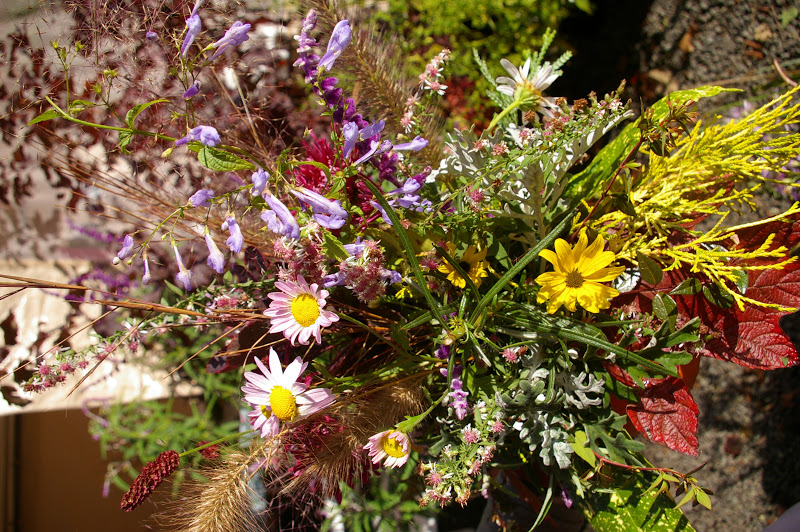
The Daily DuBrule
Today I ran a free workshop for anyone interested in participating called Playing with Pumpkins. I do this every year and am always so excited about the results. My goal is to walk people through our gardens and open up their eyes the the wide variety of material still looking good that can be used as a cut flower or foliage. After the hard, killing frost of a week ago, it is truly amazing what is out there!

- Hellebore foliage
- Bright red and orange Fothergilla foliage
- Purple smokebush foliage-now veined with pink
- Diamond grass plumes
- Little blue stem grass leaves- they have turned burgundy
- Purple and white beautyberries
- Helianthus salicifolius 'First Light'-flowers and foliage
- Sanguisorba flowers
- Pennisetum grass flowers-2 kinds
- Muhly grass flowers
- Acuba japonica foliage
- Golden Chamaecyparis foliage
- Buttonbush seed pods
- Caryopteris 'Sunshine Blue' foliage and blue seed pods
- All kinds of late blooming mums- Mei Kyo, Venus, Mammoth Coral Daisy, Hot Embers, Carousel, etc.
- Aster tartaricus flowers
- Tradescantia 'Sweet Kate' yellow spidery foliage
- Sciadopitys verticillata-evergreen foliage
- Salvia leucantha-purple velvety flowers
- Rabdosia longituba flowers- blue and white
- Itea foliage- now deep burgundy
- Peony foliage
- Monkshood flowers- Aconitum arendsii
I'm sure I left something out. All I know is that when we were finished I had a tent full of very happy people who learned that not only can you pick from your garden and not make a dent in it's beauty, you can also learn to arrange flowers and foliage very easily if given permission to unleash your inner designer. Why not go out and see what you can harvest from your landscape this weekend and make a pumpkin arrangement for your house? I bet you'll love it too!

Thursday, October 18, 2012
Petite and Late

The Daily DuBrule
In this post-frost universe, any perennials just starting to bloom are really important. For years I have been planting a diminutive but very durable perennial in every garden that can accommodate it to help us get through this transition time from lush gardens to barren landscape.
Allium thunbergii 'Ozowa' is just too cute. The foliage is up in early spring and looks like a really tiny chives. The buds start forming in September and mine just opened last week. It will last into November. It stands a mere 12" tall and the clumps ever-so-slowly expand to a foot or more in diameter. They can be easily lifted and split if you want to spread this little beauty around.
You have to locate this plant up front and close where you will notice it. I have used it in creative foundation plantings right near the front door. I have a clump in my courtyard where I sit on a big rock and commune with my frog (Frogman). I have many clumps on the edge of my sunny garden where I will surely notice them out the window of my office. I also have a white form- Allium thunbergii 'Album' which grows to the same size.
This is a fun plant that will surely turn heads of anyone walking slowly through your late fall garden and observing the details. If you ever see it offered, grab it. It's rare in the trade, but for those of us in the know, we wouldn't be without it.
Tuesday, October 16, 2012
Natives Gone Rouge
 |
| A few years ago when the Coreopsis integrifolia was happy. |
Day 235
The Daily DuBrule
I just spent an hour liberating my Coreopsis integrifolia from my Eupatorium coelestinum. The perennial ageratum had won the battle and had engulfed this very unusual, late blooming Coreopsis that I count on for cut flowers at this time of year. I started by digging out a tarp load of plants, essentially the entire front of the border. Then I got down and dirty and started sorting out the mess. The perennial ageratum has an amazing root system. White roots run along the surface of the ground and thread their way into everything. I LOVE this plant. It blooms for 5-6 weeks in my garden, fills vase after vase with cut flowers, and attracts butterflies galore. But it truly is a thug in perennial border. The Coreopsis has long, wiry roots. I teased them all out of the Eupatorium and put them in a bucket. I found that a large grouping of old fashioned coral bells had also been swallowed up. I dug it out of the mess. I then dove into the clumps of Astilbe and hardy mums and daylilies and Echinaceas and cleaned them out as well. Crazy me, I left some of the Eupatorium in the back part of the border where it does the job it is supposed to do which is fill up the empty space when the bleeding heart that ate Middletown goes dormant. I will watch it like a hawk from now on.
 |
| No sight of the Coreopsis this year, but I found it! |
While I was at it, I also dug out countless Rudbeckia 'Goldsturm' plants that had seeded around. This is not the first time in eight years I have done this. Rudbeckias LOVE my yard, as they do most yards. I have removed them before and banished them to the back border where they can spread to their heart's content amongst the 'Midwinter Fire' dogwood. Yet they return.
Last week I dug up huge clumps of Joe Pye weed that had seeded into the middle of my blueberry patch. Another landed in the Siberian iris border next to my raised beds. They both were moved to the wild border between the pussywillows. I have planted many New England asters of colors I specifically wanted- hot pink 'Alma Potchke' and low growing 'Purple Dome'. They too have self sown, resulting in pale pink and magenta tall asters that, albeit beautiful, are out of proportion or the wrong color for the spot they landed in. Never mind that a gigantic New England aster growing in the heart of a 'Coral Fay' peony can't be good for the peony.
I adore native plants and totally want them in my yard. They are easy to care for, a magnet for pollinators, and fascinating to observe. I just have to use a heavier hand on the ones that area trying to wipe out the well laid plans of this garden designer to have the borders of her dreams.

Subscribe to:
Posts (Atom)